
Your kids and money
Kids copy the system they see.
So the first step is yours. Once your own money runs on a system, you hand it to your kids one piece at a time.
What the research says
Practice beats the big talk.
The US Consumer Financial Protection Bureau calls it financial socialisation: children pick up money habits mainly by watching how the adults around them handle money.
Researchers at the University of Cambridge found that the groundwork for later money habits, like waiting for a reward and following a simple rule, is usually in place by about age 7.
Talk often
68%
of kids whose parents talked about money with them at least once a week said they were smart about money. With less talk, it was 36%.
The age ladder
One new power at each age.
- 5
The Sort
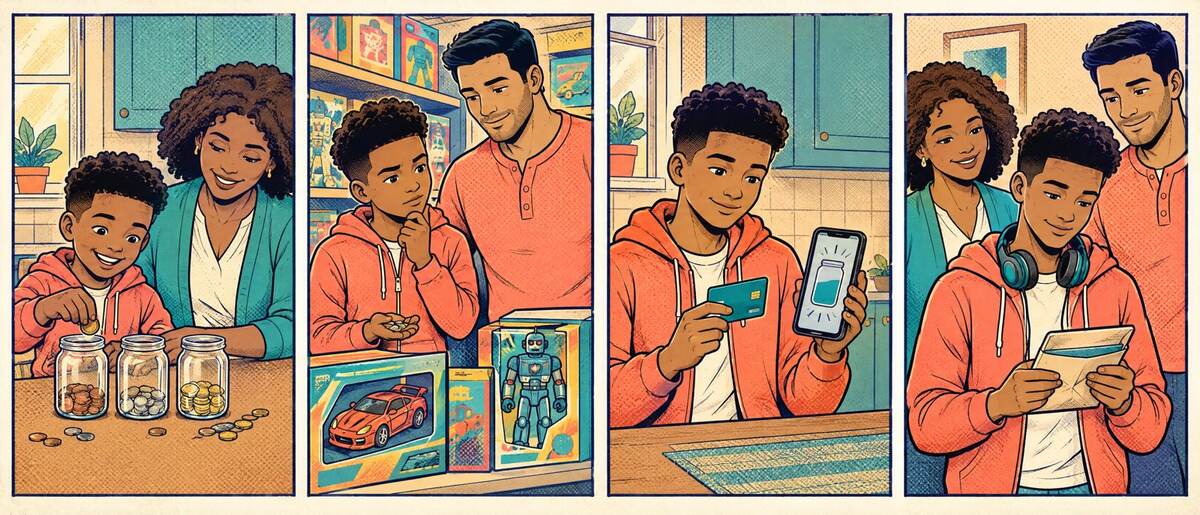
3 clear jars: Everyday, Fun and Future Me. They split the money before they spend it, and they learn to wait for something better.
- 10
The Choice
If you buy this, you can't buy that. They decide the split now, Future Me gets filled first, and they pay one real bill themselves, like the school bus.
- 13
The Operator
Each zone gets its own home: cash for Essentials, a card that stops itself for Comforts, a savings account for Future Me. They run real expenses with real money.
- 16
The Handover
A full monthly category, like clothing, run end to end. Earned income opens their own investing account. And they learn what a credit card really costs before a bank offers one.

At our house
Nour gets paid for value.
My daughter Nour is 15. She gets paid only for work that saves the family money. Normal jobs around the house earn nothing.
Her pay runs through her 3 envelopes: Essentials, Comforts and Future You. In early 2026 she worked 6 weeks at a fitness centre in Germany and put every pay toward a GPS running watch for her triathlon training.



The First Brick · free guide
Start with your own system.
The First Brick is the free guide to a family budget that runs itself. 7 steps, 9 printable sheets.